freeCodeCamp: Learn to Code for Free with Certifications
Discover freeCodeCamp, the 100% free platform with 13+ certifications in programming, Python, JavaScript, web development, and more.
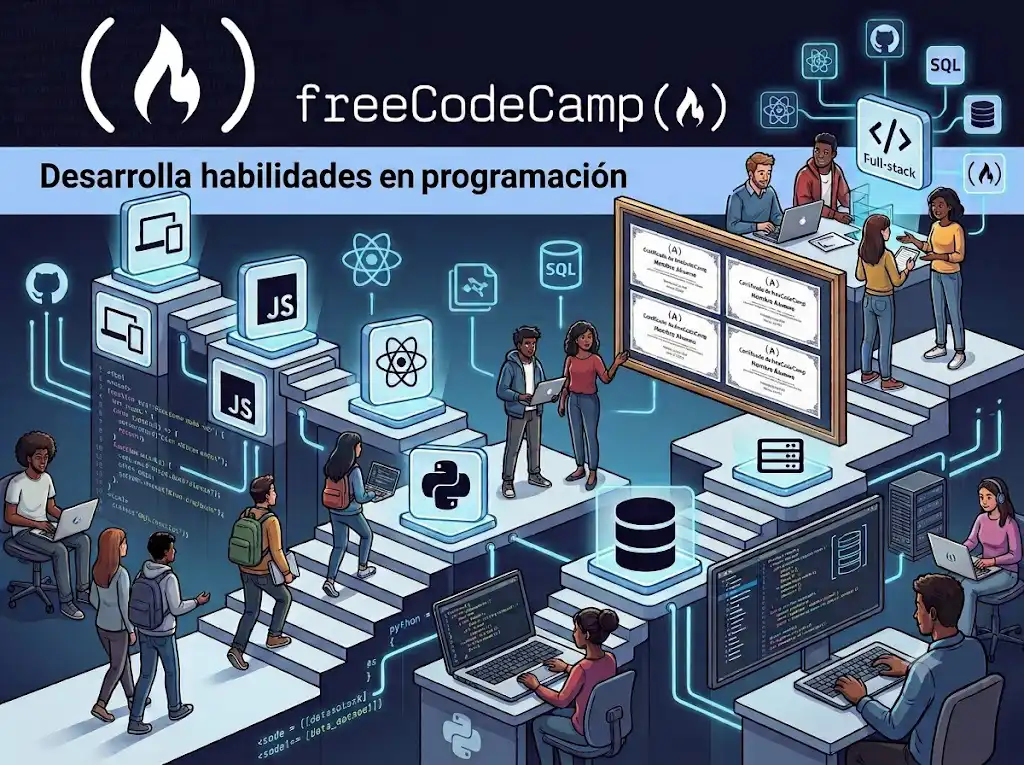
You want to learn to code. You open Google, search “programming courses,” and 200 platforms pile on promising to turn you into a developer — for just $29.99 a month. You start the free trial on one, get hooked on the first few lessons, and right when you reach the interesting part: paywall.
Now imagine a platform where everything is free. The courses, the projects, the certifications. No trial period, no locked features, no surprises next month. And one that has also helped more than 40,000 people land their first job as a developer.
It exists, it’s called freeCodeCamp, and it’s probably the best free resource for learning to code in the world.
freeCodeCamp: The Free Platform That Changed Programming Education
freeCodeCamp is a nonprofit organization founded by Quincy Larson in 2014 with a direct mission: help people around the world learn to code completely for free.
It’s not a “freemium” model where the free version is a stripped-down version. Every aspect of freeCodeCamp is 100% free: the courses, the hands-on projects, and even the verifiable certifications you can add to your resume and LinkedIn.
As a 501(c)(3) public charity registered in the United States, freeCodeCamp is funded exclusively through donations. There are no investors pushing to monetize, no intrusive ads, no user data to sell. Every dollar donated translates into more than 50 hours of learning for people worldwide.
By the numbers: freeCodeCamp helps more than 1 million people every day, has an open-source curriculum that has helped over 40,000 people land their first job as developers, and its YouTube channel is one of the largest in the world for tech education.
Over 13 Free Certifications and Learning Paths
What sets freeCodeCamp apart from random YouTube tutorials or blogs is its structured curriculum organized into certifications. Each certification represents approximately 300 hours of dedicated learning and culminates with hands-on projects you must complete to earn the certificate.
Web Development Certifications
| Certification | Technologies | What You Learn |
|---|---|---|
| Responsive Web Design | HTML, CSS, Flexbox, Grid | Design websites that adapt to any device |
| JavaScript Algorithms and Data Structures | JavaScript, ES6+, Regex, OOP | Programming logic, algorithms, and data structures |
| Front End Development Libraries | React, Redux, jQuery, Bootstrap, Sass | Build dynamic interfaces with modern frameworks |
| Data Visualization | D3.js, JSON APIs | Create interactive data charts and visualizations |
| Back End Development and APIs | Node.js, Express, MongoDB, Mongoose | Build servers and complete RESTful APIs |
| Quality Assurance | Chai, Mocha, advanced Node.js | Automated testing and quality assurance |
| Information Security | HelmetJS, Python, penetration testing | Web security and application protection |
Python and Data Science Certifications
| Certification | Technologies | What You Learn |
|---|---|---|
| Scientific Computing with Python | Python fundamentals | Python programming from scratch with a scientific focus |
| Data Analysis with Python | Pandas, NumPy, Matplotlib | Data analysis and visualization with Python |
| Machine Learning with Python | TensorFlow, neural networks | Fundamentals of artificial intelligence and machine learning |
| College Algebra with Python | Python + mathematics | Applied college algebra with programming |
Specialized Certifications
| Certification | Technologies | What You Learn |
|---|---|---|
| Relational Database | PostgreSQL, Bash, Git | Design and management of relational databases |
| Foundational C# with Microsoft | C#, .NET | C# programming endorsed by Microsoft |
About the certificates: Each freeCodeCamp certification generates a verifiable certificate with a unique link you can share on LinkedIn, your portfolio, or your resume. These aren’t decorative diplomas — thousands of recruiters recognize these certifications as evidence of practical skills.
Learn by Doing: The Interactive Learning Method
freeCodeCamp doesn’t make you watch 3-hour videos in a row. Its method is based on learning by doing: you write real code from the very first lesson.
Step-by-Step Interactive Learning
Each lesson follows this pattern:
- You read a brief explanation of the concept (2-3 paragraphs maximum)
- You see an example of working code
- You write your own solution in a browser-based editor
- The system automatically checks whether your code is correct
- You advance to the next lesson or receive feedback to fix your solution
There are no theoretical assessments like “choose the correct answer.” Every exercise requires you to write code that works. If it doesn’t pass the automated tests, you don’t advance — that simple and that effective.
Hands-On Projects to Build Your Portfolio
At the end of each certification, you must complete 5 hands-on projects that demonstrate what you learned. These projects aren’t guided exercises — you receive the requirements and you decide how to implement them.
Some examples of real projects:
- Responsive Web Design: Build a tribute page, a form, a landing page, and a technical documentation page
- JavaScript: Create a Roman numeral converter, a phone number validator, and a cash register
- Front End Libraries: Develop a calculator, a Pomodoro timer, and a drum machine with React
- Data Analysis with Python: Analyze demographic data, visualize medical data, and predict sea level rise
These projects become portfolio pieces you can showcase to employers. They’re not “hello world” exercises — they’re functional applications that demonstrate real skills.
Full Content in Spanish: Learn in Your Language
One of the biggest barriers to learning programming in Latin America is language. Most quality resources are in English, and translations are usually partial or low quality.
freeCodeCamp has a full Spanish version available at freecodecamp.org/espanol that includes:
- Interactive curriculum translated into Spanish
- Articles and tutorials on the Spanish blog
- Educational videos in Spanish on their YouTube channel
- Community forum with a Spanish section where you can ask questions and get help
This isn’t a Google automatic translation — it’s content adapted and reviewed by freeCodeCamp’s Spanish-speaking community.
Comparison with Other Programming Platforms in 2026
How does freeCodeCamp compare to the most popular alternatives?
| Feature | freeCodeCamp | Codecademy | Platzi | Udemy |
|---|---|---|---|---|
| Price | 100% free | $17.49/mo (Pro) | $49/mo | $10-200 per course |
| Certifications | Yes (free) | Yes (Pro only) | Yes (paid) | Yes (paid) |
| Hands-on projects | 5 per certification | Limited (free) | Yes | Varies |
| Interactive exercises | Yes (all) | Yes (limited free) | Videos + exercises | Videos only |
| In Spanish | Yes (complete) | Partial | Yes (native) | Varies |
| Open source | Yes | No | No | No |
| Nonprofit | Yes (501c3) | No (company) | No (company) | No (company) |
| Community & forum | Yes (active) | Yes (Pro) | Yes | No |
Fundamental difference: The other platforms are companies that need to generate revenue — the free tier will always be a limited version designed to convert you into a paying user. freeCodeCamp is a charitable organization where free truly means free, with no asterisks or fine print.
The Community: You Don’t Learn Alone
Learning to code on your own can be lonely and frustrating. freeCodeCamp solves this with one of the largest and most active programming communities in the world:
- Community forum: Thousands of threads where you can ask for help with exercises, share projects, and resolve technical questions. The community responds quickly and respectfully — there’s active moderation
- YouTube channel: One of the largest tech channels in the world with full-length tutorials spanning several hours on specific frameworks, languages, and tools
- Blog/Publication: Technical articles written by community developers on current topics — from basic concepts to advanced software architecture
- Mobile apps: Available for iOS and Android, letting you practice exercises from your phone anytime
For job seekers: freeCodeCamp has an active network of graduates on LinkedIn. Completing certifications and sharing them on your profile connects you with a community of over 40,000 people who got jobs as developers following the same path.
Recommended Learning Path for Beginners
If you’ve never written a line of code, this is the path that will take you from zero to functional web developer:
Phase 1: Web Fundamentals (Months 1-2)
Start with Responsive Web Design. You’ll learn HTML and CSS from scratch and build your first web pages. By the end, you’ll have 5 portfolio projects and your first certification.
Phase 2: Programming with JavaScript (Months 3-5)
Continue with JavaScript Algorithms and Data Structures. This is where you learn to think like a programmer: logic, algorithms, data structures, and object-oriented programming.
Phase 3: Frameworks and Full Development (Months 6-9)
Move on to Front End Development Libraries (React) and Back End Development and APIs (Node.js). After completing both, you’ll be able to build complete web applications from start to finish.
Alternative Path: Python and Data
If you’re more interested in data science or artificial intelligence, after the web fundamentals you can take the route of Scientific Computing with Python → Data Analysis with Python → Machine Learning with Python. If you’re passionate about AI, complement it with our article on restoring photos with artificial intelligence to see practical applications.
How to Get Started for Free Today
- Open freecodecamp.org/espanol from any browser
- Create a free account (you only need an email address)
- Choose your first certification — we recommend Responsive Web Design for beginners
- Complete the lessons at your own pace — no deadlines or pressure
- Build the 5 final projects and earn your certification
No cost, no deadline, no limits. You can take all the certifications you want, in whatever order you prefer, dedicating whatever time you can. freeCodeCamp adapts to your pace, not the other way around.
If you’re already coding and want tools for your workflow, don’t miss our Git tutorial from scratch — version control is a skill every developer needs to master.
Is It Worth It for Learning to Code in 2026?
In a world where educational platforms compete for your credit card, freeCodeCamp is an anomaly: a nonprofit organization that offers over 13 professional certifications, thousands of hours of content, and a global community — all completely free.
It’s not perfect. It doesn’t have Platzi’s audiovisual production or Udemy’s famous instructors. What it has is something more valuable: a proven curriculum that has taken more than 40,000 people from not knowing how to code to working as professional developers.
If you have a browser, an email address, and the desire to learn, you don’t need anything else.
Open freeCodeCamp and write your first line of code today.