
ECity Simulator: Learn Renewable Energy Free with PBL
Discover ECity, the free power plant simulator that uses Problem-Based Learning to teach energy engineering in your browser.
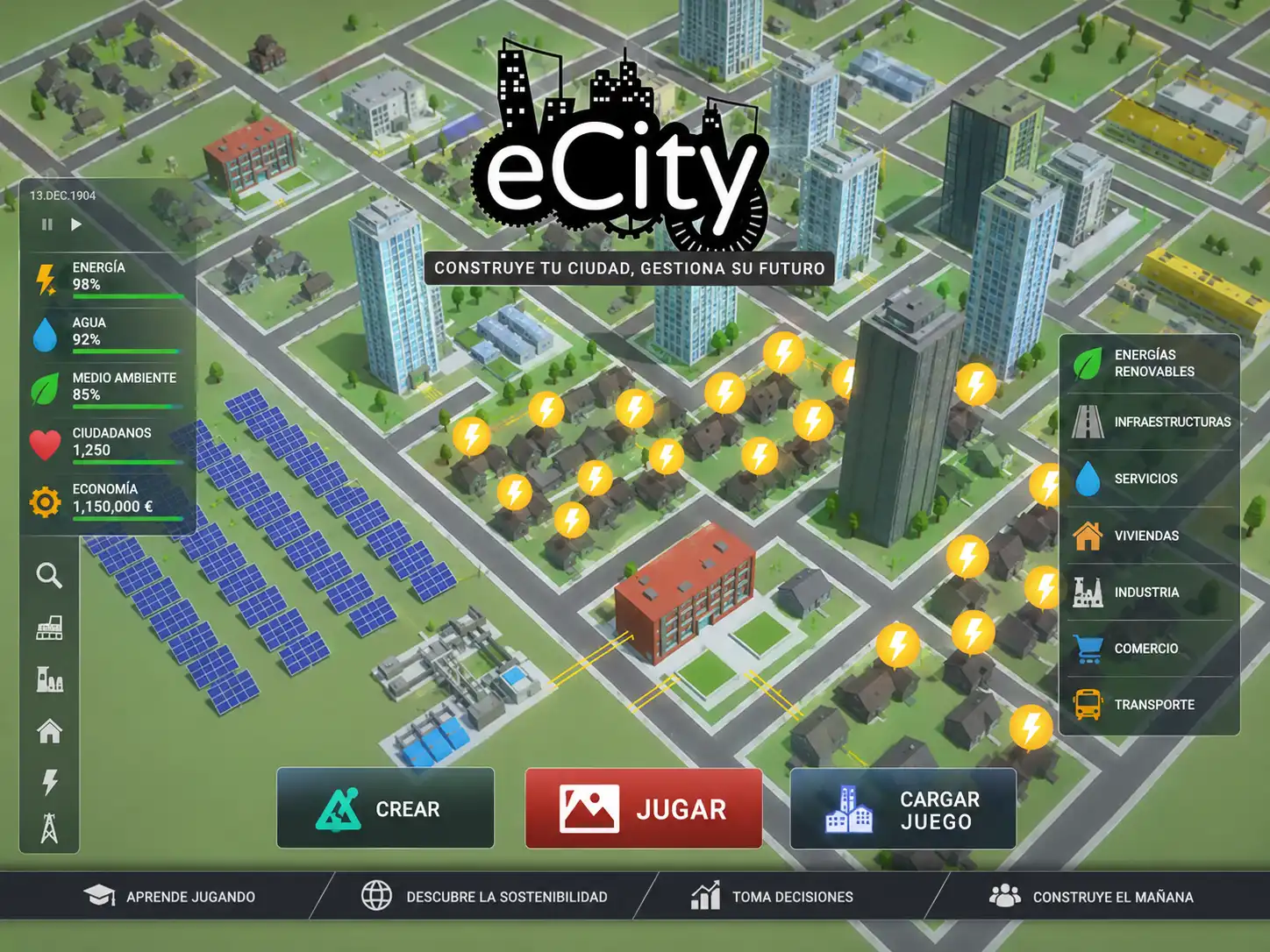
Imagine you are given a piece of land, a limited budget, and the responsibility of supplying electricity to an entire city. Would you bet on solar panels, wind turbines, or a hydroelectric plant? One wrong decision and the city goes dark.
That is exactly the challenge ECity presents — and you do not need to be an engineer to get started. Just a browser and a desire to learn.
The Free Problem-Based Learning Platform for Energy
ECity is a completely free educational simulator that allows students to design, build, and operate their own power plant in an interactive virtual environment. Its pedagogical engine is Problem-Based Learning (PBL), an approach where knowledge emerges from facing real challenges, not from memorizing formulas.
Unlike lecture-based classes where the student is a passive spectator, in ECity you make the decisions: which energy source to use, where to locate the plant, how to manage costs, and what to do when something fails.
Why PBL? Pedagogical studies show that students retain up to 75% more knowledge when they learn by solving real problems, compared to 5-10% from a traditional lecture.
From Land to Operating Plant: How the Simulation Works
The simulator’s dynamics place the student at the center of every decision. The process unfolds in progressive phases:
Phase 1: Site Selection and Renewable Energy Sources
You choose the geographic location of your plant and decide among the available renewable sources:
- Solar — photovoltaic panels for high-radiation areas
- Wind — turbines for regions with consistent winds
- Hydroelectric — harnessing water currents
- Biomass — converting organic matter into electricity
Each option has advantages and limitations that depend on the terrain, climate, and available resources. There is no universal “correct” answer — just like in real engineering.
Phase 2: Design, Construction, and Cost Management
Once the source is selected, you design the infrastructure and balance critical variables simultaneously:
- Availability of natural resources in the chosen area
- Environmental impact of your installation
- Investment costs vs. generation capacity
- Long-term operational efficiency
Phase 3: Unexpected Setbacks and Critical Decision-Making
This is where ECity separates itself from any basic simulator. As your plant operates, the system introduces unexpected events:
- Technical breakdowns in key equipment
- Regulatory changes affecting your operations
- Supply crises for raw materials
- Adverse weather conditions that reduce production
Each decision generates visible consequences in real time. If you ignore a breakdown, your production drops. If you fail to adapt to new regulations, you receive penalties. It is a cycle of trial and error that turns every mistake into learning.
PBL vs Traditional Lectures: A Method Comparison
| Criterion | ECity (PBL) | Traditional Lecture |
|---|---|---|
| Student role | Active protagonist | Passive spectator |
| Knowledge retention | ~75% | 5-10% |
| Practical application | Immediate (real decisions) | Deferred (exams) |
| Feedback | Instant and visual | Weeks later (grades) |
| Teamwork | Built into the dynamic | Occasional |
| Error tolerance | Errors are part of the process | Errors are penalized |
| Cost | Free | Variable |
Benefits for Students and Teachers
Hands-On, Safe Experience in a Virtual Lab
ECity turns theory into practice within an environment where making mistakes has no real consequences. A student can crash their power plant, analyze what went wrong, and rebuild it with a different approach — something impossible with real infrastructure.
Autonomy and Critical Thinking in Energy Engineering
The simulator forces students to make decisions with incomplete information, evaluate alternatives, and take responsibility for the results. Exactly what they will face in their professional lives.
Collaborative Work and Team Problem-Solving
ECity facilitates teamwork, allowing students to enrich their solutions from diverse perspectives. A student with a technical vision can complement another with an economic mindset, simulating real engineering teams.
Immediate Feedback: Every Error Is a Lesson
There is no waiting weeks for a grade. Every action produces a visible result instantly, creating a cycle of continuous improvement that reinforces knowledge on the go.
Who Is This Simulator Designed For
ECity is not exclusive to university engineering students. Its accessible design makes it ideal for different profiles:
- High school students with a tech vocation who want to explore the energy sector before choosing a career
- Early-year university students in electrical, environmental, or mechanical engineering
- Teachers looking for a free tool to energize their classes with PBL methodology
- Self-learners interested in understanding how renewable energy plants work
If you are interested in discovering more free educational tools, you can also explore our article on the Wokwi electronic circuit simulator, another platform that brings hands-on practice to the browser.
How to Start Using ECity for Free from Your Browser
- Go to the ECity Simulator from any browser
- Select a simulation scenario and your energy source
- Design your power plant and manage the available resources
- Face the setbacks the system introduces and adapt your strategy
- Analyze the results and optimize your plant with each iteration
No installation, no registration, no cost. ECity runs directly in the browser and is designed so you can start learning in minutes.
Is It Worth It as a Renewable Energy Educational Tool?
In a world that urgently demands professionals capable of leading the energy transition, ECity positions itself as the perfect pedagogical ally. It is free, accessible from any device with a browser, and turns energy engineering into a hands-on, immersive experience.
It does not just teach technical concepts — it cultivates a problem-solving, critical, and sustainable mindset in those who are called to design the energy future.
Ready to build your first power plant? Open ECity and start making decisions that matter.